
Use case
Fast BAFU inspection for climate-claim workflows
When climate-related wording such as carbon-neutral or certified electricity needs to be checked, the first job is often not a polished report. It is a fast, inspectable pass through the underlying process data. Volca makes that first pass much easier on an open Swiss-rooted database.
A good current hook: climate claims must be clear and verifiable
A recent FOEN communication focused on climate-related wording and the need for terms such as carbon-neutral to be clear, accurate, and verifiable. That is exactly where fast database inspection matters: before making a claim, you want to see what the process actually contains, what sits immediately upstream, and where a carbon narrative would need more explanation.
What this use case shows
- fast search on an open BAFU dataset
- direct upstream inspection on the process record
- full resolved upstream supply-chain browsing
- inventory filtering for carbon-dioxide-related rows
Why BAFU works well here
- public and shareable inspection surface
- Swiss-rooted dataset with serious industrial structure
- good for showing what is actually in a process before interpretation
- useful alongside more established proprietary references
What Volca adds
The point is not to turn one screenshot into a verdict. The point is to reduce the friction of getting from a claim-related question to the actual process structure, upstream contributors, and inventory evidence that a human still needs to interpret carefully.
Concrete walkthrough: inspect Swiss certified electricity before repeating the claim
1. Start from the words people actually use
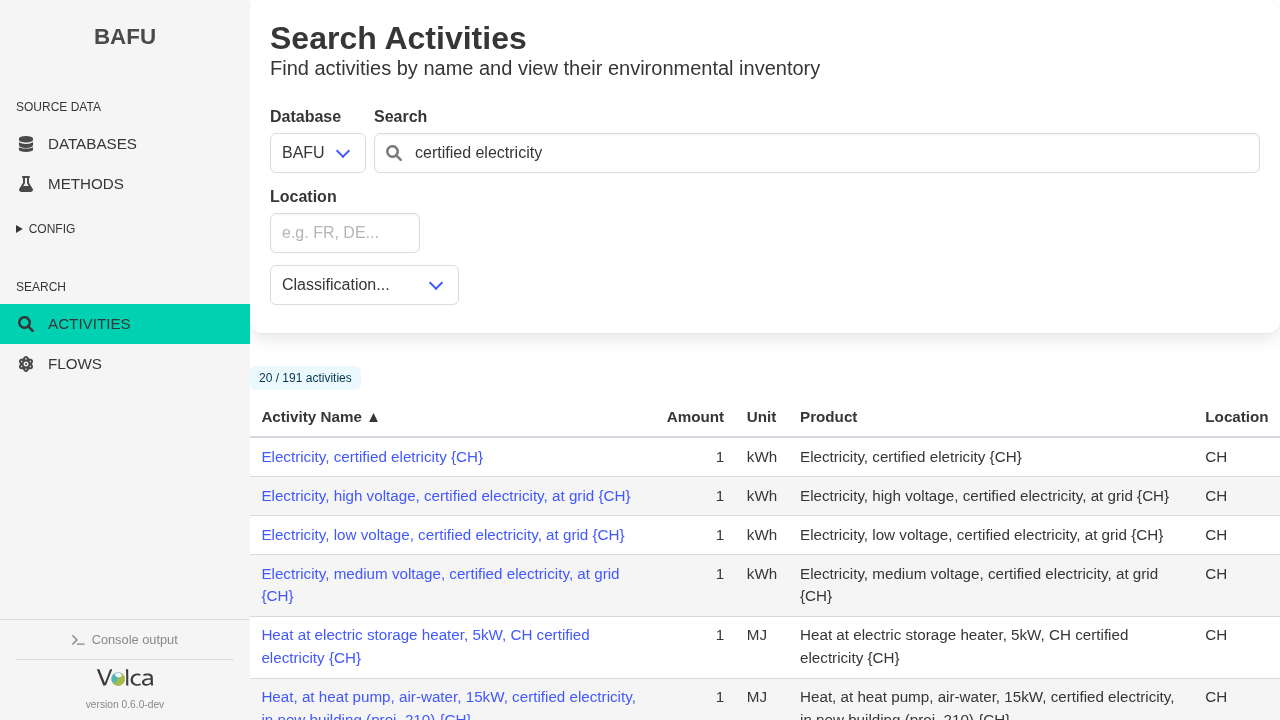
Search the BAFU database for certified electricity
A fast search already gives you the useful variants: the generic Swiss process plus high-, medium-, and low-voltage grid versions. That is a much better starting point than arguing from marketing language alone.
2. Inspect the immediate process structure
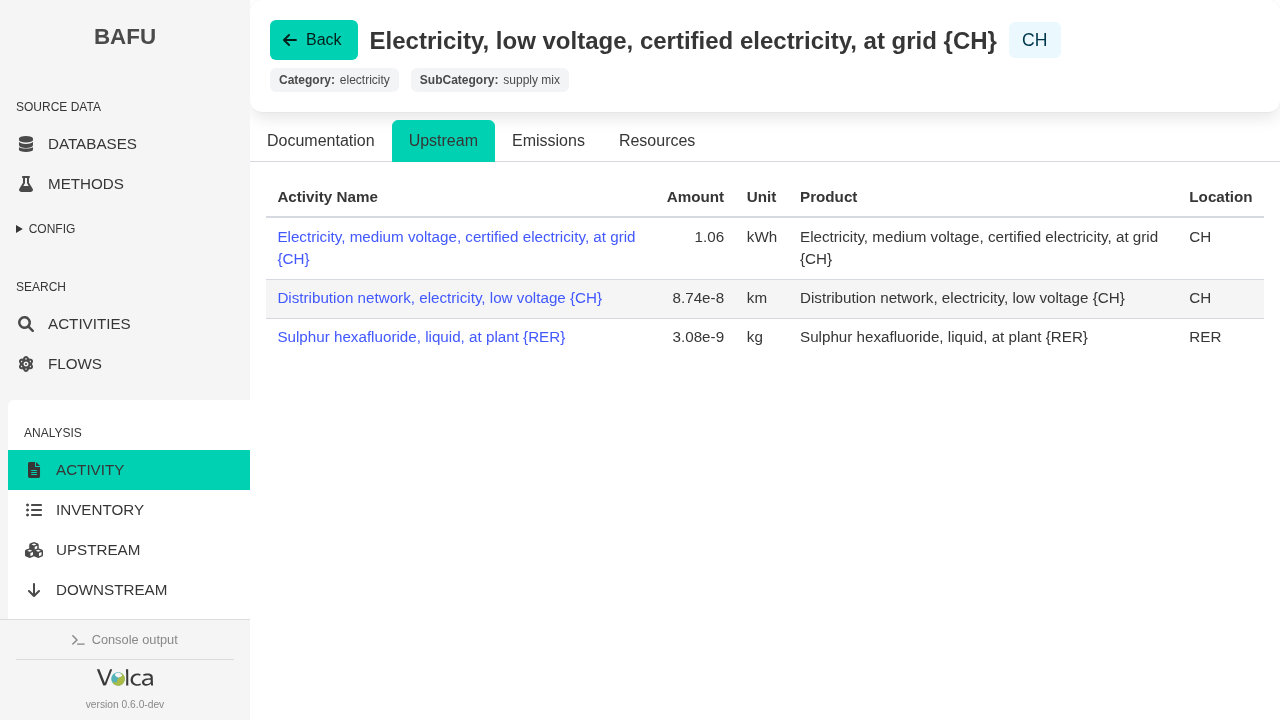
Open the low-voltage Swiss process and look at the direct upstream tab
For Electricity, low voltage, certified electricity, at grid {CH}, the direct upstream tab is immediately informative. You can see the medium-voltage certified electricity input, the low-voltage distribution network, and even a small sulphur-hexafluoride-related input without leaving the activity page.
3. Expand from direct inputs to the resolved supply chain
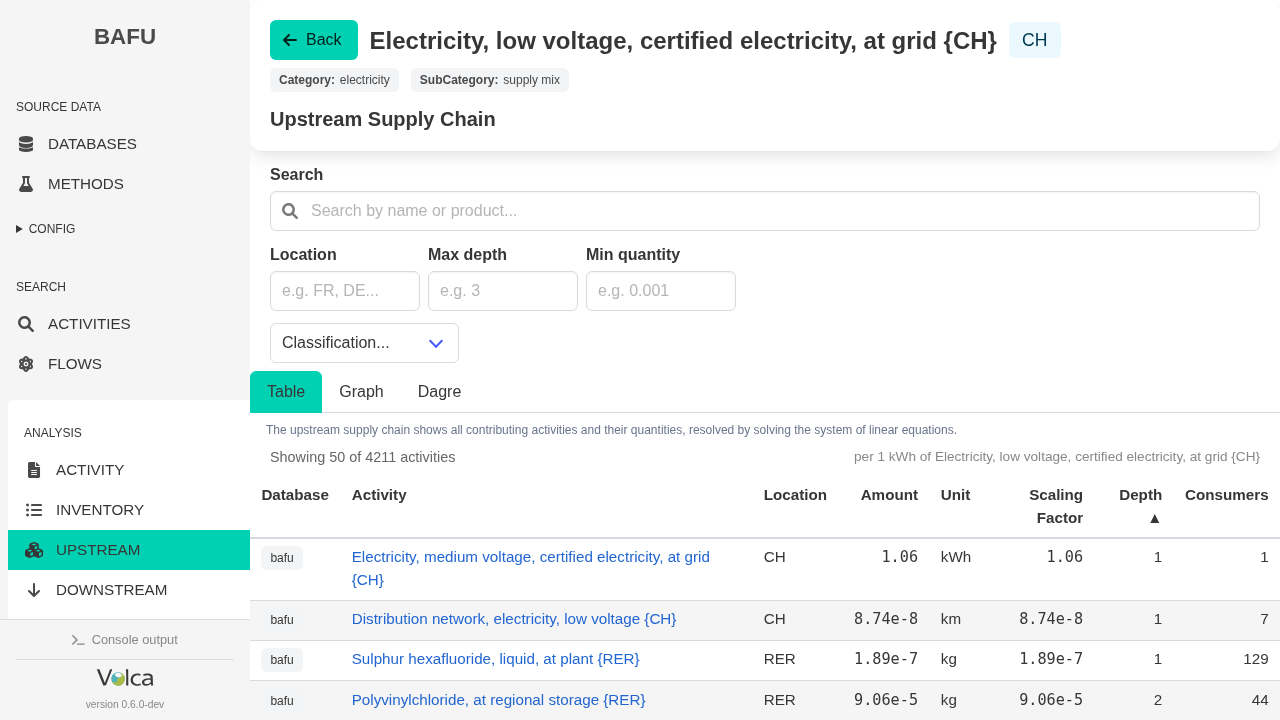
Open the full upstream table and see the wider process web
One more click opens the resolved upstream supply chain. The process is no longer just “certified electricity”: you can see infrastructure, materials, transport, and higher-voltage electricity layers appearing in the actual chain behind 1 kWh of supply.
4. Filter the full inventory on the signal you care about
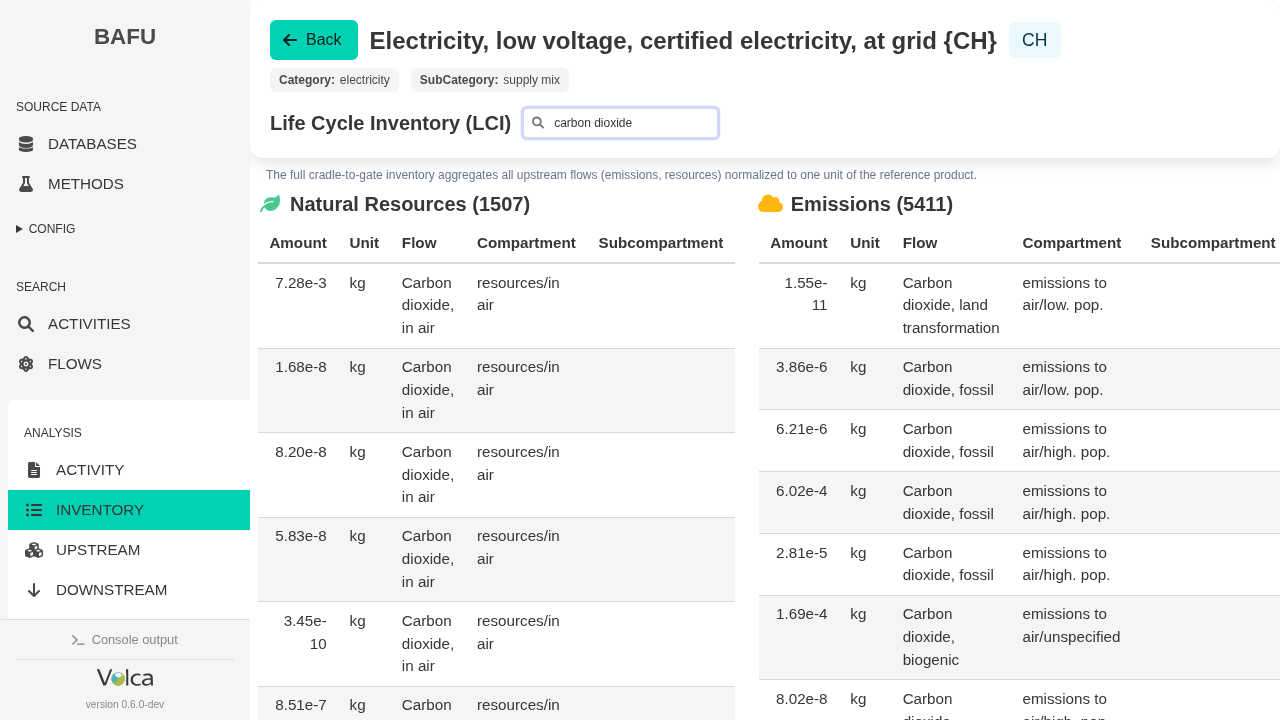
Search the life-cycle inventory for carbon dioxide
The full inventory view lets you move from process labels to actual inventory evidence. Filtering with carbon dioxide immediately surfaces carbon-dioxide-related rows under both resources and emissions, which is exactly the kind of traceability you want before making or repeating a strong climate claim.
What this page is — and is not
This page is a proof that Volca can make a serious open database quickly inspectable when a climate-related claim needs evidence, context, and challengeability. Public datasets like this are increasingly useful in transparent workflows, and teams can use them wherever they need shareable, inspectable process evidence.
Current scope
This BAFU page currently focuses on fast browsing and inspection on a public Swiss-rooted database: search, direct upstream visibility, resolved supply-chain browsing, and inventory filtering. It is a proof of inspectability first.